
SEC Oversight and AI-Washing
As more companies incorporate AI into their services, product offerings, and overall strategy, they often highlight their use of AI in corporate strategy discussions and marketing to investors. However, regulators have cautioned that companies should be wary of “AI Washing,” which often refers to making false, misleading, or exaggerated claims about the use or capabilities of artificial intelligence in products, services, and business operations. “AI Washing” can also refer to the trend of some companies blaming layoffs on AI implementation (stay tuned for a future blog post on AI’s effect on labor & employment trends).
AI washing refers to misleading or exaggerated claims about how companies use artificial intelligence.
Companies may engage in AI washing by:
Claiming to use AI when no such technology is deployed;
Overstating the sophistication or autonomy of AI systems;
Misrepresenting how AI influences business decisions; or
Suggesting proprietary AI capabilities that do not exist.
This practice closely resembles “greenwashing,” in which companies portray themselves, or their products and services, as more environmentally friendly or sustainable than they actually are in an effort to boost sales or attract investors.
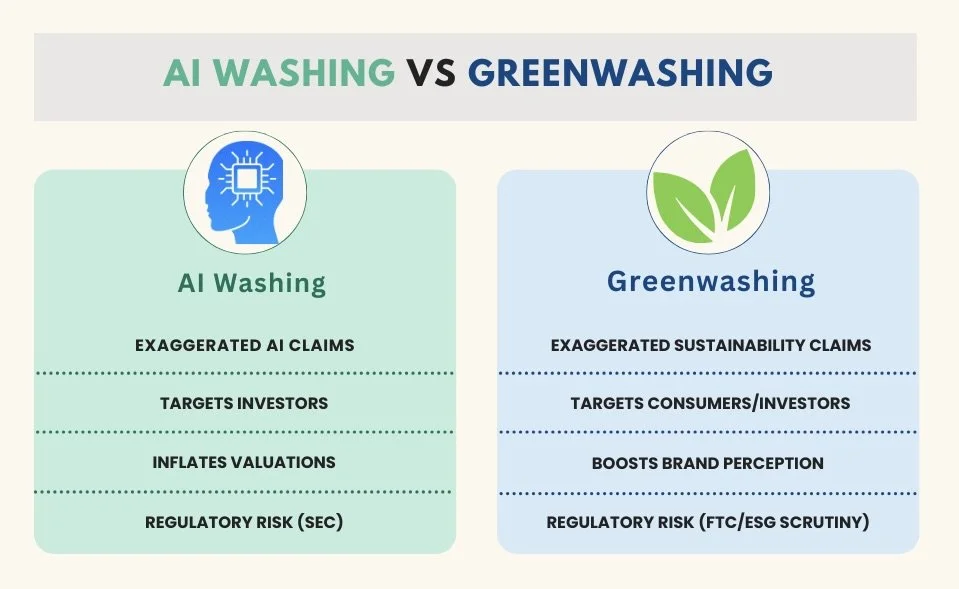
AI washing and greenwashing both involve misleading claims—applied to technology and sustainability, respectively.
Why Regulators Are Concerned
In recent years, the U.S. Securities and Exchange Commission (SEC) has signaled that exaggerated or misleading claims about AI may constitute securities fraud, marketing rule violations, or other forms of deceptive conduct. AI-related claims can be material to investment decisions, as investors often perceive AI capabilities as indicators of innovation, competitive advantage, and future growth. The concern is that exaggerated AI claims can artificially inflate valuations or obscure business realities, especially in sectors where AI-driven innovation is a key selling point. SEC leadership has emphasized that companies must have a reasonable basis for AI-related representations and must avoid misleading disclosures about how AI is used in their operations.
SEC Enforcement Actions
The SEC began signaling serious scrutiny of AI washing in 2024, when it brought its first enforcement actions against investment advisers accused of misrepresenting their AI capabilities in SEC filings, press releases, and on their websites. The SEC charged Delphia (USA) Inc. and Global Predictions Inc. with making false and misleading statements regarding their use of AI in investment strategies and financial advisory services. The firms allegedly marketed AI-powered tools that did not exist or were not used as described. The firms ultimately agreed to settle the SEC’s charges and pay $400,000 in total civil penalties. These cases were widely viewed as a signal that regulators intended to treat AI-related misstatements like any other misleading disclosure under federal securities laws.
In April 2025, the SEC and the Department of Justice (DOJ) filed parallel actions in the Southern District of New York against Albert Saniger, the founder of Nate Inc. (Nate), alleging that he made false and misleading statements to investors about the company’s purported AI technology. Saniger marketed his product, a mobile shopping app, as a cutting-edge technology that used AI, machine learning, and neural networks, and raised over $42 million in three years. The app promised one-click checkouts and sophisticated automations to streamline user’s online shopping experiences. However, a June 2022 news report questioned these claims and funding stalled. The company ceased operations and dissolved in January 2023, resulting in millions of dollars in losses for investors. According to the SEC, instead of AI, Nate’s app relied on contract workers overseas who manually processed transactions. The SEC charged Saniger with violations of Section 10(b) of the Securities Exchange Act of 1934 and Rule 10b-5 thereunder, as well as Section 17(a) of the Securities Act of 1933, and the DOJ alleged that Saniger committed securities fraud and wire fraud.
Disclosure and Compliance Lessons
The rise of AI washing allegations highlights broader disclosure challenges. Because “AI” can refer to a wide range of technologies from simple automation to advanced machine learning, and vague or ambiguous descriptions may mislead investors about what a company actually does. Given heightened scrutiny, companies should consider several steps to mitigate risk:
Substantiate AI claims. Ensure that any statements about AI capabilities have a factual basis.
Align public statements across platforms. Marketing materials, SEC filings, and investor presentations should be consistent.
Implement internal review processes. Legal and compliance teams should vet AI-related disclosures and promotional statements.
Monitor evolving enforcement trends. Regulators continue to refine their approach to AI-related disclosures, and it is important to stay up to date on SEC enforcement of AI-related