
2026 Employment Law Updates: AI Regulations
Several states have regulations and laws going into effect that govern the use of AI in employment decisions, including:
The California Civil Rights Department finalized regulations clarifying that the anti-discrimination provisions in the Fair Employment and Housing Act (FEHA) apply to automated decision systems, including AI. Discriminatory outcomes (including disparate impacts) on the basis of protected characteristics like race, gender, age, disability, religion, or national origin are prohibited whether the decision is made by humans or aided by AI. https://cppa.ca.gov/regulations/ccpa_updates.html
Texas implemented a law prohibiting the development or use of an AI system with the intent to unlawfully discriminate against a protected class. https://capitol.texas.gov/tlodocs/89R/billtext/html/HB00149F.htm
New Jersey adopted regulations governing disparate impact discrimination in the workplace, which includes the use of automated employment decision technology such as AI. https://aboutblaw.com/bks1
Illinois requires employers to provide employees with notice of the use of AI for recruitment, hiring, promotion, discipline, or termination of employment. The new law clarifies that it is a civil rights violation to use AI in a way that discriminates against a protected class. https://www.ilga.gov/Legislation/BillStatus?DocNum=3773&GAID=17&DocTypeID=HB&LegId=149031&SessionID=112&GA=103
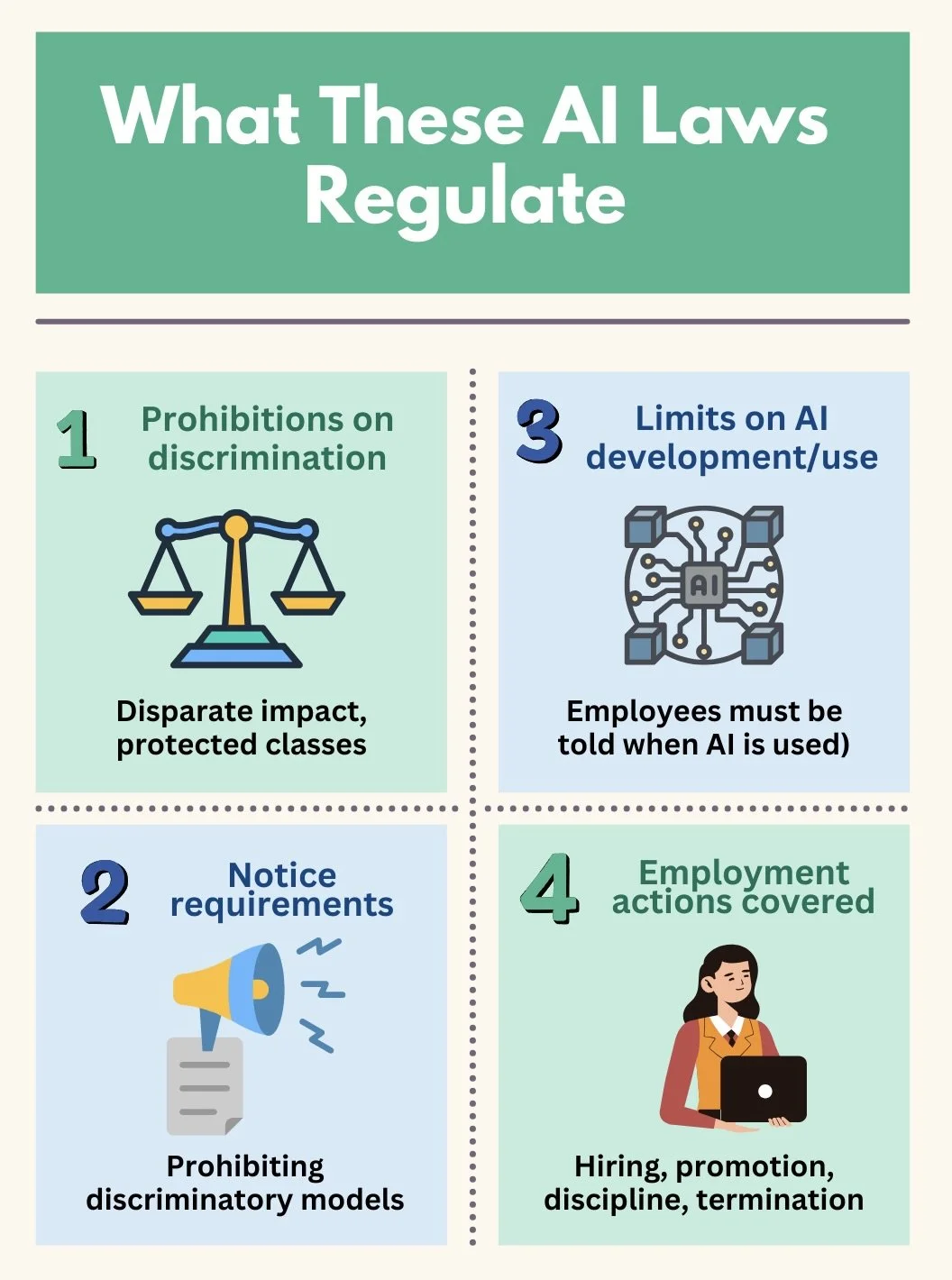
States are now regulating not just outcomes, but how AI is used in employment decisions.
As we previously shared, start-ups should be aware of potential risks when using AI in the hiring process: https://www.frymanpc.com/blog/the-litigation-risks-of-using-ai-in-hiring-what-startups-should-know-about-employment-law-compliance
As states continue to develop legal frameworks for the use of AI in employment decisions, the federal government is also weighing in. In Dec 2025, President Donald J. Trump signed an Executive Order, the “Ensuring a National Policy Framework for Artificial Intelligence,” which asserts broad federal authority over state AI laws that are viewed as harmful to innovation. https://www.whitehouse.gov/presidential-actions/2025/12/eliminating-state-law-obstruction-of-national-artificial-intelligence-policy/
This Executive Order establishes a “minimally burdensome” national AI governance framework; creates a DOJ AI Litigation Task Force; directs federal agencies to challenge state requirements deemed inconsistent with federal priorities; and conditions certain funding on states placing a pause on enforcement of certain AI statutes. This Executive Order may face legal challenges from states seeking to enforce their own AI regulations.
If you have specific questions about using AI in recruitment and hiring, and the changing regulatory landscape, let’s connect and make sure your business is protected against potential discrimination claims.