
Responding to Cease and Desist Letters: A Strategic Guide
A cease and desist letter arrives and your stomach drops. A lawyer is accusing you of something, using words like "infringement" and "damages" and "further legal action." Your first instinct is to panic. Your second is to fire off a response defending yourself.
Resist both instincts.
The redundantly named cease and desist letter is not a lawsuit. It is not a court order. It is a letter from a lawyer that’s specifically designed to induce panic and discomfort. Understanding that is the first step towards responding strategically rather than emotionally.
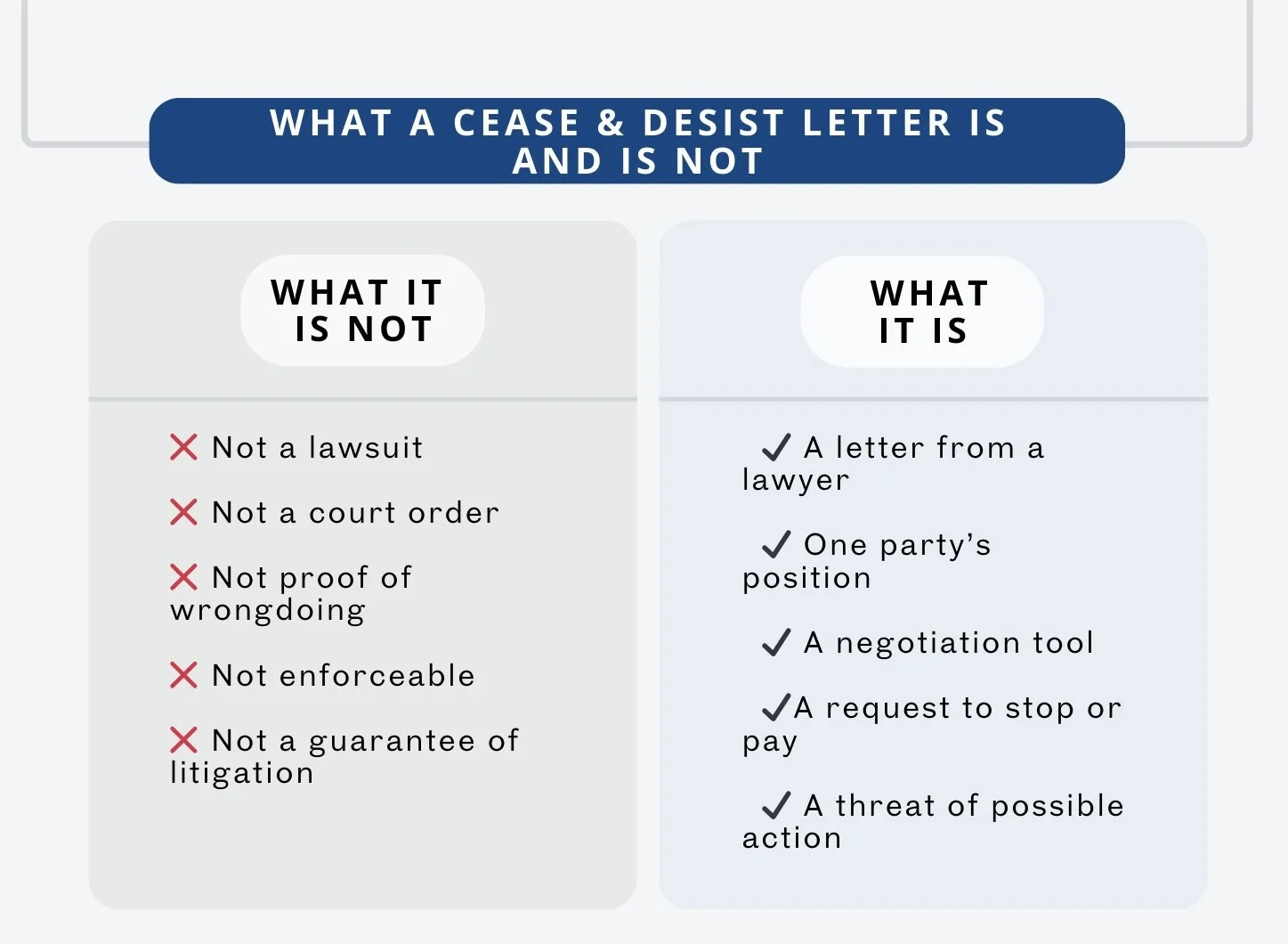
Understanding what a cease and desist letter actually means helps you respond strategically.
Common accusations include trademark infringement, copyright infringement, patent infringement, trade secret misappropriation, breach of contract (often a non-compete or NDA), or defamation.
The letter typically demands you stop the allegedly wrongful conduct, sometimes demands money, and warns of litigation if you don't comply.
Here's what it isn't. It isn't a finding of wrongdoing. It isn't enforceable on its own. It doesn't mean you'll be sued. It is one party's position, drafted by their advocate, presenting facts in the light most favorable to their client. That's what lawyers do.
First Slow Down
The single most important thing you can do is not respond immediately.
Read the letter carefully. Understand exactly what they're accusing you of and what they're demanding. Note any deadlines. Then set it aside and think.
Responding in haste creates problems. An emotional reply can include admissions that hurt you later. A defiant response can escalate a situation that might have been resolved quietly. Even a well-intentioned response can waive privileges or create a record that works against you.
Seven to fourteen-day deadlines are negotiation pressure, not court orders. Ask for time if you need it; you'll usually get it.
Evaluate the Claims
Before deciding how to respond, assess whether the accusations have merit.
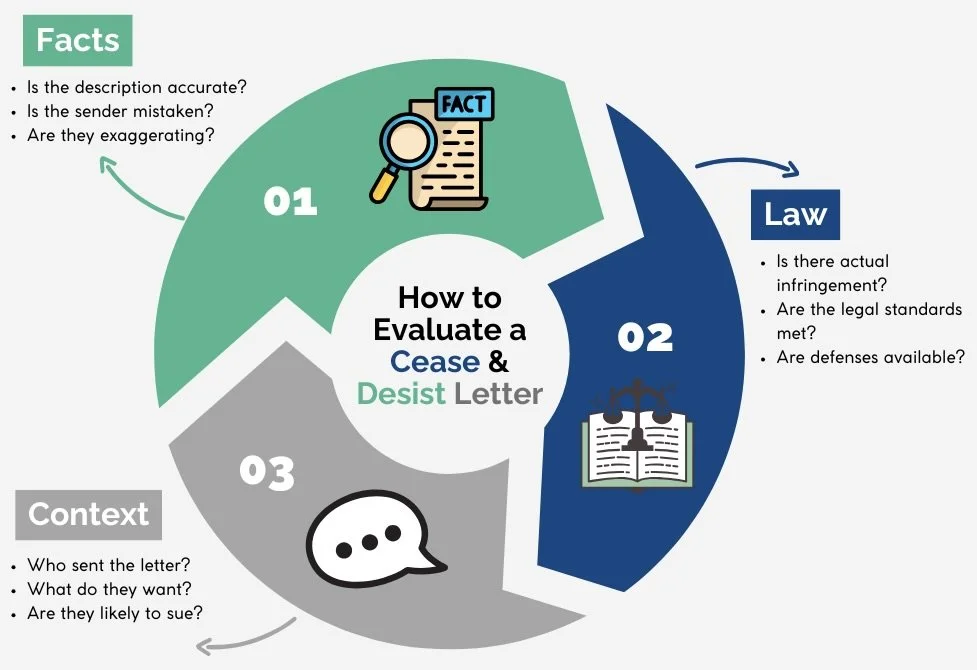
Evaluate the facts, the law, and the business context before choosing a response strategy.
Start with the facts. Is the letter accurately describing what you're doing? Sometimes the sender is operating on incomplete information. Other times they're exaggerating to strengthen their position.
Then consider the law. Even if the facts are accurate, the sender may be wrong about whether your conduct is unlawful. Trademark infringement requires likelihood of consumer confusion, not just similar names. Copyright infringement requires copying of protected expression, not just similar ideas. Contract claims require an enforceable agreement and an actual breach.
This is where a lawyer becomes useful. You may have strong defenses you're not aware of. You may also have more exposure than you realize. An honest assessment of your legal position is essential before you decide on strategy.
Ask practical questions as well. Who sent the letter? A large company with litigation resources, or a small competitor hoping you'll fold? What's the business context? What do they actually want? Sometimes the letter demands you stop using a name, but the real goal is a licensing fee. Understanding motivations helps you craft a response.
Your Strategic Options
Once you understand what you're facing, you're standing in a hallway with four doors.
Door one: Do nothing. Sometimes the best response is no response. If the claims are weak and the sender is unlikely to sue, ignoring the letter may be appropriate. Many cease and desist letters are sent with no intention of following through. The sender is hoping you'll capitulate without a fight. The risk is that silence can be interpreted as defiance, and some senders will escalate.
Door two: Comply. If the claims have merit and the demanded changes aren't burdensome, compliance may be the pragmatic choice. This is especially true when the cost of fighting exceeds the cost of changing course. Compliance doesn't mean admitting wrongdoing. A response can acknowledge the sender's concerns, confirm you've made changes, and explicitly state you're not conceding liability.
Door three: Negotiate. Many disputes end in settlement. Common outcomes include licensing agreements, coexistence agreements for similar marks, modified conduct, or mutual releases. Negotiation works best when both parties have something to lose from litigation and something to gain from resolution.
Door four: Fight. If the claims are baseless and you're prepared to defend yourself, a strong response can shut down the matter. This might mean a detailed rebuttal explaining why their claims fail, a demand they withdraw their accusations, or a preemptive declaratory judgment lawsuit. Fighting requires resources and risk tolerance, but sometimes it's the right call.
Many people fixate on door four. Don't. The goal is not to win an argument; it's to resolve a problem at the lowest cost to your business. Sometimes that means standing your ground. Often it means finding a door that gets you out of the hallway faster.
How to Respond
Once you've chosen your door, a few principles matter.
Be professional. Regardless of how aggressive the sender's letter was, your response should be measured. Courts and opposing counsel notice tone. A professional response positions you as the reasonable party.
Be precise. Address the specific claims. If they mischaracterized facts, correct the record. If their legal theory is flawed, explain why. Vague denials are less persuasive than specific rebuttals.
Be careful about admissions. Don't concede facts or liability unnecessarily. Phrases like "we didn't intend to infringe" can be read as acknowledging that infringement occurred.
Preserve your options. Avoid language that locks you into a position you may want to abandon later.
When to Get a Lawyer
Not every cease and desist letter requires counsel. If the claims are clearly frivolous and the stakes are low, you may handle it yourself.
But consult a lawyer if the claims have potential merit and the exposure is significant, if you're considering business changes in response, if the sender appears prepared to litigate, if the dispute involves complex issues like patents or trade secrets, or if you're unsure how to evaluate the strength of their position.
A lawyer can help you figure out which door makes sense and how to walk through it without tripping. Early involvement is usually cheaper than cleaning up a poorly handled response.
Practical Takeaways
For business owners: resist the instinct to panic. Resist the instinct to fire back. Treat the letter as a move, not a verdict. Slow down, assess, respond with intent.
For in-house counsel and executives: this is a business problem, not just a legal problem. The right response depends on competitive dynamics and risk tolerance, not just who has the stronger argument. Loop in the right stakeholders before committing.
For lawyers sending cease and desist letters: your letter is the first impression your client makes. Aggressive posturing may feel satisfying, but a firm, professional letter that accurately states the facts is more likely to achieve your client's goals than a screed that puts the recipient on the defensive